
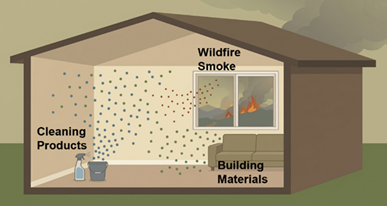
Beyond the immediate destruction of life, structures, and landscapes, wildfires also release harmful pollutants into the air that can infiltrate indoors and persist long after the flames are extinguished. The air people breathe at home in the weeks and months following wildfires can be a serious health concern. In a new study published in ACS ES&T Air, researchers from the Harvard Healthy Buildings team and collaborators from the LA Fire HEALTH Study measured 24 volatile organic compounds (VOCs) inside and outside 50 homes across Los Angeles County in the two months following the devastating 2025 LA wildfires. The study offers one of the most detailed looks to date at residential chemical exposure during the postfire recovery period, including which chemicals are of greatest concern, where they come from, and how home conditions and occupant behaviors shape what people are actually breathing.
Here are three key takeaways from this study:
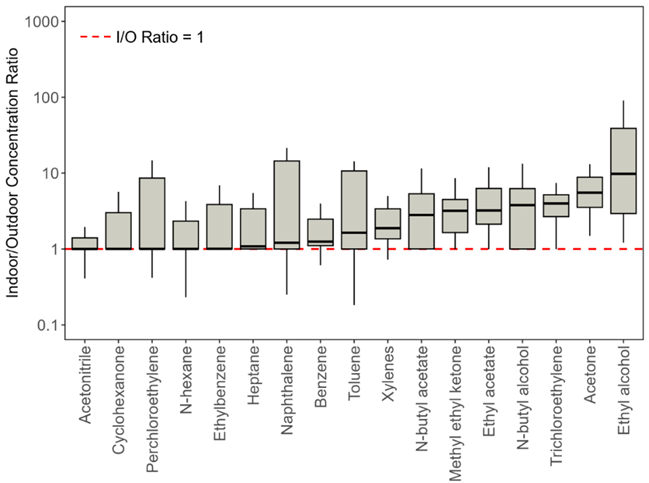
1. Indoor air was often more polluted than outdoor air. For most VOCs measured, indoor concentrations were up to 10 times higher than outdoor concentrations, reflecting strong sources inside the home.
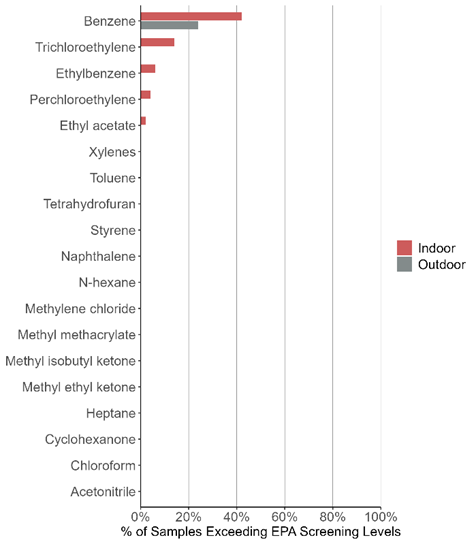
2. Most measured VOCs were below health-based risk limits. Indoor benzene exceeded the U.S. EPA cancer risk screening level in 42% of homes (and the stricter California threshold in 52% of homes), while outdoor benzene exceeded the EPA level at 24% of sampling locations. Trichloroethylene and perchloroethylene were elevated indoors at lower frequencies. All other measured VOCs were generally below their screening levels with exceedance rates < 10%.
3. Most indoor VOCs traced back to household products and building materials, but one chemical hinted at lingering smoke. Statistical source analysis identified household products (particularly cleaning agents) and off-gassing from building materials as the dominant sources of most indoor VOCs. Naphthalene, a known marker of biomass combustion, stood out as the one compound with a possible wildfire signal. The detection rate of naphthalene was relatively low, so this finding will need to be confirmed in larger-scale studies.
These findings underscore the importance of distinguishing wildfire-specific contributions from everyday indoor and urban sources when designing residential air quality interventions after a fire. The study also highlights a small set of compounds that warrant particular attention in postfire settings, with benzene, trichloroethylene, and perchloroethylene posing potential health risks, and naphthalene flagged as a possible marker of lingering smoke worth tracking in future work. Together, these insights can help inform VOC exposure assessments, targeted mitigation strategies, and public health guidance for communities recovering from wildfires.
Read the full study: https://doi.org/10.1021/acsestair.5c00508