
Table of Contents
Share this Page
Advancing Sustainable Development of Ukraine
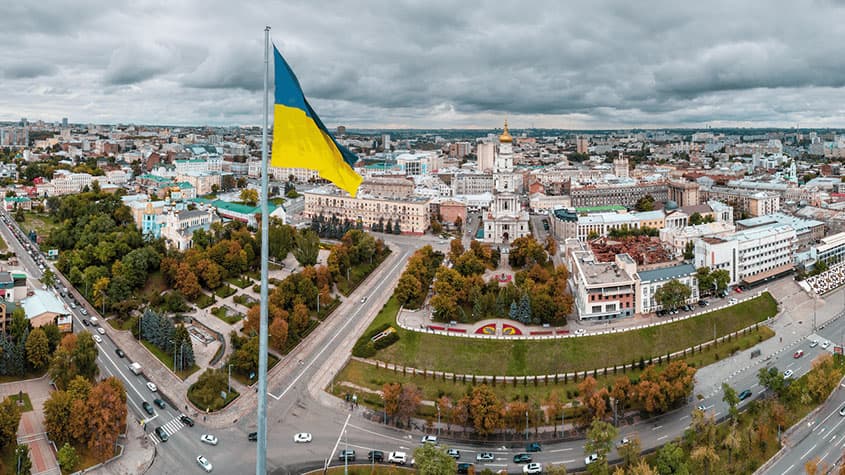
What does it mean to simultaneously rebuild a country while fighting an invader for four and a half years? When early hopes of joining the European Union, with conformance to regulations, markets, and external expectations, instead has Europe eyeing your country as a paragon of technological innovation and economic adaptation? ? How should Ukraine move forward to deliver societal reconstruction in ways that are both expedient and demonstrate long-term vision?
While we recognize Ukraine’s existing expertise in sustainability and public health matters, the situation calls for a much wider workforce well-educated on these topics. How can Ukraine most effectively “Build forward better?”
Our third course iteration is dedicated to the sustainable reconstruction of Post-War Ukraine and will continue to prepare Ukrainian professionals to lead rebuilding efforts across various sectors. Through interactive lecture sessions, in-person convenings, and collaborative project application, from ninety to one hundred initiative-taking Ukrainian participants will gain the knowledge and apply their newly formed skills to rebuild infrastructure, communities, and regulatory systems in an environmentally and socially responsible manner. Course instruction will be well integrated into the European social, financial, and regulatory framework under the mentorship of experienced professionals working in these sectors.
This course will again be offered free of charge by the Harvard T.H. Chan School of Public Health in collaboration with our coalition partners: the Institute of Global Prosperity at the University College of London, the London School of Economics, Ukraine’s Dixi Group, and with the shared ownership and planning of our Ukrainian course alumni from previous years. Growing on our previous offerings, this year’s course will be laser-focused on enabling resilient, sustainable reconstruction that supports public health, climate-forward solutions, and energy independence as affordable and financially successful models for Ukraine. However, it will also greatly advance an understanding of the urgency of entrepreneurship, innovation, and financing solutions that catalyze recovery. The course mission is to leverage Ukrainians’ existing expertise in building, infrastructure, project development and finance, legal frameworks, and urban planning and transition the country’s dynamic workforce into leadership roles to manage the reconstruction process sustainably as an intrinsic principle. We will introduce and weigh international best practices, case studies, research, and project frameworks with the aim of delivering authentic Ukrainian solutions appropriate to pressing needs.
Apply Now
The deadline to apply is August 30, 2026.
Questions can be directed to the Harvard course leader, Dr. Linda Powers Tomasso at tomasso@hsph.harvard.edu or to Viktor Riabokin at viktor@vidbudova.org.
Background
The Harvard Chan School, with its expertise in sustainable cities, energy technologies, healthy buildings and climate resilience, stepped forward in 2024 as an academic partner to systematically present and work together with Ukrainians to transition reconstruction projects toward sustainability. We have centered these projects for collaborative learning in creating our current course curriculum.
The ensuing course is an interdisciplinary effort that draws on the expertise of Harvard Chan faculty members (healthy buildings, nature, climate and health), and other collaborating Harvard Schools, expanding to our institutional university partner, the Institute of Global Prosperity at UCL to augment the curriculum around policymaking, public-private partnerships, green energy and financing, innovation, entrepreneurship and prosperity. Course content differs from other reconstruction programs in that it is anchored in a strong focus on public health (mental health and trauma informed design), resilience, economic and societal transformation other programs do not cover. Another pillar of the course is the multisectoral professional background of its participants, which helps to prepare truly robust joint reconstruction projects.
Course Objectives and Participant Outcomes
The primary objective of this course is to expose mid-tier Ukrainian professionals to the methods and mindset of sustainable approaches to rebuild their country. Specifically, participants will learn to:
- Evaluate how to balance expediency with longer-term vision in the reconstruction process
- Engage private sector into reconstruction and build blended finance models
- Create a framework for social entrepreneurship in Ukrainian municipalities based on clear case study
- Bring an entrepreneurship mindset to Ukrainian municipalities and the State
- Have the agency to understand the complex system involved in reconstruction and choose the best next step for progress
- Reconceptualize prosperity for the recovery of Ukraine
Build networks and capacity to prepare state and municipal governments, as well as the private sector, to undertake reconstruction projects in a sustainable manner. Participants will have the knowledge and networks to lead interdisciplinary teams implementing sustainable reconstruction strategies across Ukraine. Project groups will continue to collaborate on initiatives that support rebuilding efforts in an environmentally, socially, and economically responsible manner through practicums and partnerships which can extend beyond the two-semester course window.
We again seek to identify strong candidates to form a participant cohort able to contribute to the long-term training needs of Ukraine’s reconstruction efforts. We aim to equip participants to use insights gained for project development and implementation, leadership, advocacy, and policymaking to implement solutions that serve Ukraine’s long-term public health, climate preparedness, and energy independence needs and overall quality of reconstruction projects.
By attending the course, participants gain the added benefit of connecting with the alumni network and becoming part of the community. Over the years, 140 experts have graduated from the program.
Course Format
The course will be held across two semesters, Fall 2026 and Spring 2027, as a weekly two-hour live online session around a topic lecture and participant discussion. Attendance of no less then 80% of lectures and additional activities across both semesters is expected of applicants. (Please do not apply if you cannot commit to this timeframe, as demand for this course previous years exceeded placement opportunities by a 4-to-1 ratio.)
The Fall 2026 semester will begin in late September and end in mid-December. The Spring 2027 semester will run from early February until mid-May.
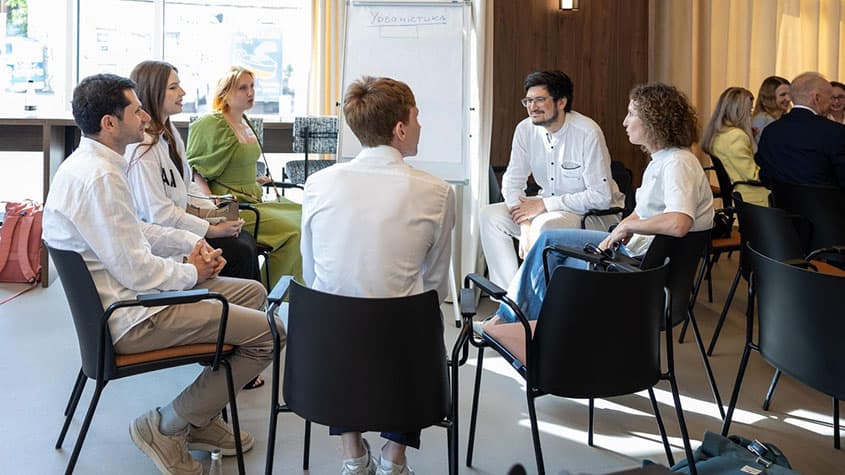
Course participation will also include assignment to a project development group. Each group will work on a real-life reconstruction project proposed by the Ukrainian Ministry, a municipality, or the private sector. These projects will be led by course alumni. These projects are in blueprint or early development stages and offer the opportunity to translate participants’ professional interests and learning to an actual reconstruction challenge.
Prospective Participants
Who is this course intended for?
This comprehensive program is intended for skilled and committed Ukrainian professionals from all sectors, private and public, whose background training primes them to take part in the reconstruction process. These include but not limited to specialists in infrastructure building, energy specialists (at infrastructure and building levels), architects and designers, urban planners, transportation managers and engineers, Ukrainian legislative and national-level policy makers, urban health officials (related to healthy buildings, transit, physical activity), educators (green schools and nature access), representatives from municipalities, business, academia, civil society and public authorities. Please note, however, that this course is not meant for clinicians, despite its origin in a school of public health.
We seek a commitment from course applicants to remain proactively engaged with the course lectures, affinity group work and additional formats of collaboration across both semesters, asking questions, participating in discussion providing their own ideas and comments .
What Qualifications are Required of Participants?
A strong command of English is recommended for the lecture presentations and discussions which follow.
Priority will be given to applicants who meet the following criteria:
- Ukrainian nationals currently residing in or outside of Ukraine with 4+ years of professional experience in fields related to, but not limited to, construction, engineering, architecture, project management, real estate development, energy generation, energy planning, finance, sustainability consulting, policymaking and legislation, urban planning, landscape design, public health, NGO leadership, and public sector management.
- Interest in delivering sustainable development or infrastructure projects incorporating green building standards, renewable energy systems, climate resilience strategies, low-carbon financing, or other relevant practices.
- Experience in a field of interest to reconstruction such as those listed above.
- An undergraduate or advanced degree (e.g., Master or Ph.D.) or professional certification (LEED AP, etc.) in a related field is preferred but not required.
- Fluency in Ukrainian and English (proficient since course will be taught in English).
- Ability to participate regularly and reliably across 80%+ live sessions for both semesters.
The selection process will include a written application with video expressing motivation for joining and a participatory interview/collective discussion on reconstruction.
This program is NOT aimed at individuals intending to continue their careers outside of Ukraine’s process of reconstruction. We expect all participants to contribute their professional careers in or for post-war Ukraine, taking on leadership roles championing sustainable practices throughout the reconstruction process, as evidenced by a personal statement and outside recommendations.
What is Expected of Course Participants?
All candidates selected for this course are expected to participate in:
- A two-hour online lecture sessions over 24 weeks delivered at Wednesdays, 6.30 pm Kyiv time, by a subject matter expert.
- Workshops, Debates, Networking sessions, which will be taking place in hybrid format,
- An assigned project development groups comprised of participants of complementary expertise, guided by a Ukrainian project specialist and/or subject matter expert. Each project group will be responsible for developing an area of thematic concern to be carried out throughout the course.
We understand that difficult situations reign in a country still at war. If you feel you would otherwise be a positive addition to our program, we ask you to apply nonetheless. Once we identify you and your skills as a candidate for our program, we will contact you and try to find a solution that accommodates your situation.
Thematic Course Blocks
Block 1. Foundations and Strategic Vision (3 sessions)
Context-setting: demographics, economy, what “sustainable reconstruction” means, resilience in wartime, success cases + the innovation narrative.
Block 2. Rules of the Game: Legal Framework, EU Integration, Standards (4 sessions)
EU accession, legal aspects of reconstruction, green building certifications, EU Taxonomy, quality control.
Block 3. , Leadership, Governance, and Institutional Capacity (3 sessions)
State transformation leadership, stakeholder communication, bottom-up/community-level projects.
Block 4. Human Capital, Public Health and Sustainability (3 sessions)
Climate change, mental health, trauma-informed design, inclusivity, NGOs/grassroots
Block 5. Urbanism, infrastructure and energy (4 sessions)
Climate/health risk, war debris/waste, urban planning, renewable energy transition.
Block 6. Finance, Investment and Procurement (5 sessions)
Key controversial topics like public investment pipeline, procurement, PPP, blended finance and fundraising, risk mitigation and impact valuation
Block 7. Innovation and the Enterpreneurship (3 sessions)
Innovations, entrepreneurship, private-sector engagement, social entrepreneurship
Course Instructors
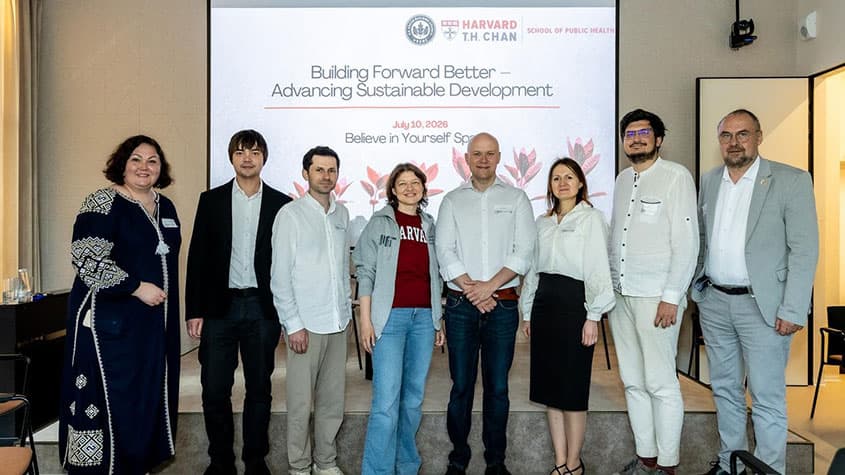
An experienced international group of Ukrainian, European and Harvard experts will contribute to the course by presenting lectures, leading discussions and advising collaborative teamwork on actual Ukrainian sustainable development projets. Their education and background will shape real-world solutions to reconstruction opportunities in both the public and private sectors.
Ukrainian Course Organizers
- Viktor Riabokin
- Viktoria Trotska
- Konstyantyn Turchak
Institutional Collaborators
- Institute for Global Prosperity, University College of London
- European Institute, London School of Economics
- U.S. Green Building Council
- Institute for Sustainable Infrastructure
- The Dixi Group, Ukraine
- Green Building Council International